“Colectiva”: a look at feminisms in Latin America from the edges
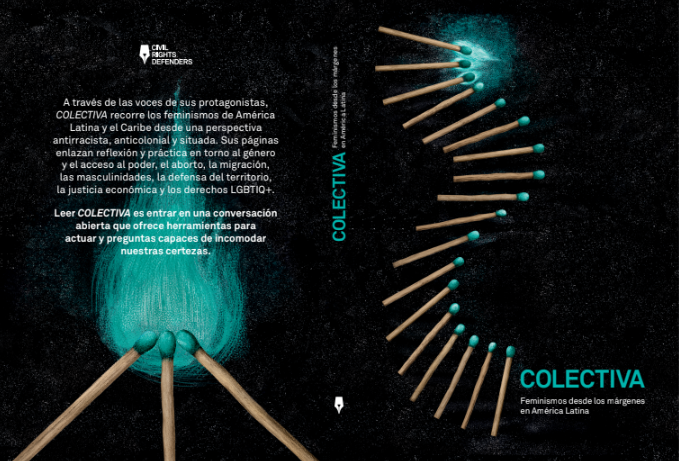
Colectiva presents a collaborative work that brings together the region’s most influential thinkers, activists, and defenders to reflect on democracy, justice, equality, and resistance in times of setbacks.
At a time when feminist and human rights movements face profound threats in Latin America, a new collective book spearheaded and compiled by Civil Rights Defenders offers more than just an analysis: a powerful conversation born from the initiative of women’s organizations in Cuba to spark an exchange with other movements in the region that—drawing on diverse territories, experiences, and struggles—are redefining the present and future of democracy, justice, and equality.
Stemming directly from the Cuban feminist movement’s desire to foster a dialogue and conversation that extends beyond its own borders, COLECTIVA brings together leading voices from across the region to critically examine the major debates of our time. From Colombian anthropologist Mara Viveros Vigoya, one of the leading theorists of intersectionality in Latin America, to K’iche’ Maya leader Andrea Ixchíu Hernández; from María Florencia Alcaraz, co-founder of Ni Una Menos. Also participating are feminist and peacebuilder Rosa Emilia Salamanca, Mexican labor activist Betty Ávalos, masculinity researcher Andrea Neira Cruz, migrant women’s rights advocate Estefanía Mendoza, and other prominent authors who, from their diverse contexts, construct a varied map of Latin American feminist resistance.
All of them engage with the experiences of Afro-Cuban writers and journalists such as María Matienzo, who brings to the forefront issues fundamental to the island’s future—such as abortion and sexual and reproductive rights, sexual dissidence, and the anti-racist and decolonial perspective of the struggle for human rights in the Caribbean nation.
Far from offering a single perspective, the publication embraces complexity. Its chapters cover topics as diverse as the defense of Indigenous territories, economic justice for maquila workers, women’s political participation, sexual and reproductive rights, the migrant experience, the challenges faced by LGBTIQ+ people, Black and decolonial feminisms, peacebuilding, and the transformation of masculinities.
One of the book’s greatest contributions is precisely its demonstration that feminisms in the region are not an abstract theory, but rather concrete practices of survival, organization, and social transformation. The authors write from their own experiences: from a political prison in Cuba to an indigenous assembly in Guatemala; from the streets of Buenos Aires during the “green tide” to the border neighborhoods of Ciudad Juárez; from women’s movements in Colombia to Latin American diasporas scattered across the globe.
The personal stories woven throughout the book help us understand how gender inequalities are intertwined with racism, poverty, colonialism, migration, and political violence. But above all, they show how women are building collective alternatives to confront these challenges and expand the boundaries of democracy in a region marked by profound inequalities.
The publication comes at a critical moment for the political reality of Cuba and the continent: the Cuban government’s direct attacks on activists, human rights defenders, and artists coexist with a marked rise in anti-rights rhetoric, attacks on gender equality, threats against women human rights defenders, and growing restrictions on civic space. In the face of these setbacks, the book champions the power of collective organization, memory, dialogue, and political imagination as fundamental tools for defending and expanding rights.
More than just a collection of essays, this work is a living archive of contemporary feminist struggles in Latin America. It is an invitation to listen to historically marginalized voices, to recognize the diversity of feminisms in the region, and to understand that the defense of human rights necessarily involves the defense of the autonomy, equality, and dignity of women and people of all diversities.