The glorification of Ratko Mladić shows why international justice matters
Following the death of convicted war criminal Ratko Mladić, Serbian authorities and officials participated in a series of commemorative events. The events have reignited questions about accountability, reconciliation and the role of international justice when perpetrators of grave crimes continue to be publicly honoured.
Ratko Mladić died in The Hague on 27 August while serving a life sentence for genocide, crimes against humanity and war crimes. But the events that followed his death have demonstrated that, more than three decades after the war in Bosnia and Herzegovina, the struggle over accountability and the legacy of those crimes is far from over.
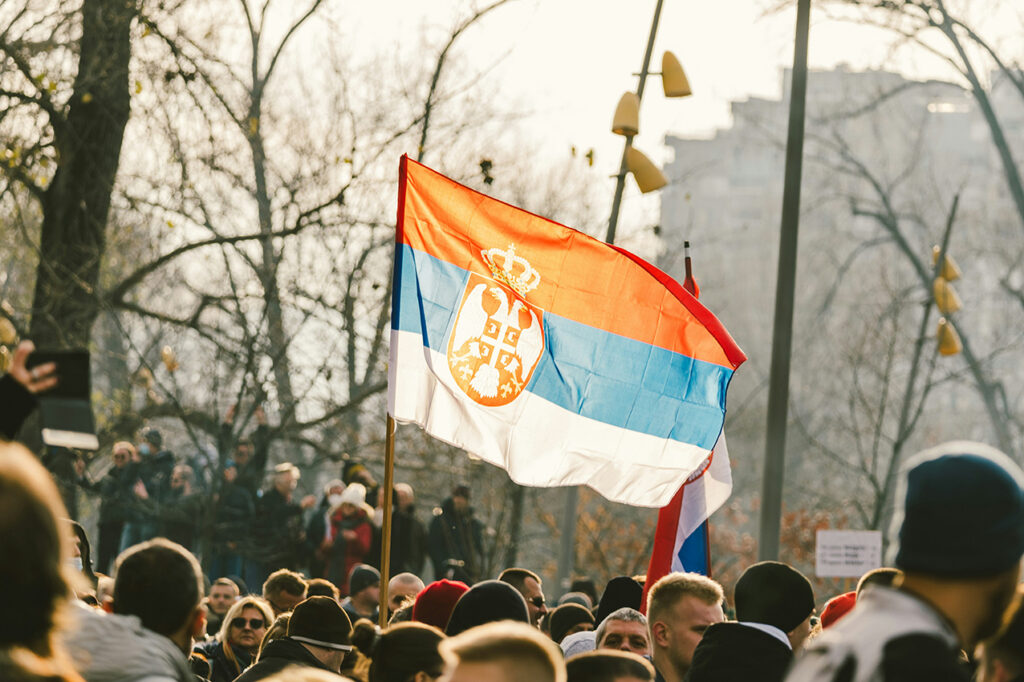
When Mladić’s remains were returned to Serbia, they arrived aboard a Serbian government aircraft. Serbian Army soldiers carried his coffin, draped in the Serbian flag, from the plane. A commemoration was subsequently held at the House of the Serbian Army, and thousands of people attended his funeral in Belgrade. The funeral included military honours and was attended by several Serbian government ministers, President Aleksandar Vučić’s son and other political figures. The Serbian Orthodox Patriarch led the religious service.
Although the funeral was not formally designated a state funeral, the elements of official involvement were unmistakable.
The response from Serbia’s institutions matters because there should be no ambiguity about what Mladić was convicted of.
What the courts established
Ratko Mladić was the commander of the Main Staff of the Army of Republika Srpska during the 1992–1995 war in Bosnia and Herzegovina.
In 2017, the International Criminal Tribunal for the former Yugoslavia convicted him of genocide, crimes against humanity and violations of the laws or customs of war and sentenced him to life imprisonment. The International Residual Mechanism for Criminal Tribunals upheld his convictions and sentence on appeal in 2021.
His convictions included genocide in Srebrenica, where more than 8,000 Bosniak men and boys were killed in July 1995; persecution, extermination, murder, deportation and forcible transfer across Bosnia and Herzegovina; the campaign of sniping and shelling intended to spread terror among civilians in Sarajevo; and the taking of United Nations personnel hostage.
Established in court
These are not competing historical narratives or matters of political interpretation. They are findings reached through lengthy judicial proceedings in which evidence was examined, witnesses were heard and Mladić was afforded the right to defend himself and appeal his conviction.
Establishing and protecting such facts matters far beyond the courtroom. Democratic societies depend on institutions and public debate that are grounded in evidence and respect judicial findings, including when those findings are politically difficult.
Acknowledging established facts is also the starting point for responsibility: without agreement on what happened and who was responsible, meaningful reconciliation becomes far more difficult.
Criminal accountability individualises that responsibility. Holding Mladić accountable for crimes established before an international court does not assign guilt to an entire people or nation. It identifies, through evidence and due process, the responsibility of specific individuals rather than attributing collective guilt.
“The public glorification of a person convicted of genocide and other grave international crimes is deeply troubling,” says Ivana Randelović, Asia and Europe Department Director at Civil Rights Defenders.
“It sends a painful message to survivors and the families of victims. It also undermines efforts to build a future based on accountability, respect for victims and an honest engagement with the past.”
Serbia’s responsibility to confront the past
Mladić was first indicted by the ICTY in 1995. Yet he remained at large for almost 16 years before he was arrested in Serbia in May 2011 and transferred to The Hague.
The failure to bring him before the Tribunal was not only a political failure. It also had consequences under international law.
In its landmark 2007 judgment in Bosnia and Herzegovina v. Serbia and Montenegro, the International Court of Justice found that Serbia had violated its obligation under the Genocide Convention to prevent the genocide in Srebrenica.
The Court also found that Serbia had violated the Convention by failing to transfer Ratko Mladić to the ICTY and, as a result, had failed fully to cooperate with the Tribunal.
Strong international courts are essential
The two international courts performed different but complementary roles. The ICTY established Mladić’s individual criminal responsibility for genocide and other international crimes. The ICJ addressed Serbia’s responsibilities as a state under the Genocide Convention.
Together, their judgments demonstrate why independent international justice mechanisms are essential when accountability for the gravest crimes is obstructed, delayed or politically inconvenient at the national level.
The Mladić case shows what international justice can achieve when domestic institutions fail for years to bring those accused of the gravest crimes before a court. No individual should be placed beyond the reach of justice because they retain political influence, institutional protection or public support.
The role of human rights defenders and civil society
The contribution of human rights defenders and civil society begins long before a judgment is delivered. During and after armed conflicts, organisations working on the ground often document violations, collect testimonies, preserve evidence and help victims and witnesses bring their experiences to the attention of accountability mechanisms. Cooperation among organisations across communities and borders can help piece together information about crimes that no single organisation or institution could document alone.
This work was particularly important in the former Yugoslavia, where international investigators initially faced serious obstacles in accessing crime scenes, witnesses and documentation. Information gathered by non-governmental and humanitarian organisations, alongside testimony from victims and survivors, contributed to the body of material available to international investigators. Courts and prosecutors independently investigate, test and assess such information according to evidentiary standards, but documentation produced by those closest to affected communities can provide important starting points, identify witnesses and help preserve information that might otherwise be lost.
That role continues after trials end. Human rights defenders and civil society organisations help ensure that judicially established facts remain accessible and present in public life. By preserving testimony, supporting victims and survivors, monitoring accountability processes and challenging denial and historical revisionism, they connect judicial findings with wider democratic debate and reconciliation. This becomes particularly important when institutions are unwilling to confront the past or political actors seek to replace established facts with narratives that serve present-day interests.
Justice is more than a conviction
International courts cannot reverse atrocities. They cannot return those who were killed or erase the suffering endured by survivors and their families. But accountability matters beyond the sentence imposed on one individual.
Judicial proceedings establish responsibility on the basis of evidence. They preserve records of crimes. They give victims an opportunity to have their experiences formally recognised. And they create a barrier against attempts to deny, minimise or rewrite atrocities after the fact.
This is particularly important in societies where convicted perpetrators continue to be presented as national heroes.
Glorification does not simply concern the reputation of one dead commander. When public institutions participate in honouring a person convicted of genocide, they contribute to an environment in which judicially established facts can be dismissed and victims can once again be marginalised. It also makes reconciliation more difficult.
For the Western Balkans, this is not only a question of how the past is remembered. Respect for established facts, acknowledgment of individual responsibility and recognition of victims are foundations on which trust between communities and neighbouring countries can be rebuilt. They strengthen democratic culture, reduce the political space for denial and nationalist revisionism, and support more durable regional cooperation.
How societies respond to the crimes of the 1990s therefore also shapes the future of the region. A stable and democratic Western Balkans cannot be built by erasing responsibility or turning convicted perpetrators into heroes, but by confronting established facts and creating space for victims, accountability and dialogue.
The judgments remain
Ratko Mladić died in detention. His criminal proceedings are over.
The judgments are not.
Neither his death nor the number of people who attended his funeral changes the crimes established by the courts or the responsibility attributed to him.
“The response to his death raises a broader question for Serbia: whether its institutions intend to confront this legacy or continue to provide space for the glorification of those convicted of the gravest crimes under international law,” says Ivana Randelović.
Serbia’s European commitments make that question particularly urgent. Respect for victims, rejection of genocide denial and war-criminal glorification, and genuine reconciliation are not peripheral questions in the accession process. They concern the fundamental values on which it is based.
International justice cannot, by itself, create reconciliation. Courts cannot substitute for political responsibility, education, memorialisation, independent journalism, civil society or honest public debate.
But the case of Ratko Mladić demonstrates what international courts can do: establish responsibility where impunity has prevailed, protect judicially determined facts from political revisionism and affirm that even those once considered untouchable can ultimately be held accountable.
Establishing facts, recognising individual responsibility and respecting victims are not only ways of addressing the past. Ensuring that those facts remain part of public life is essential to strengthening democracy, enabling reconciliation and building a more stable future for the Western Balkans.
That principle remains essential – in the Western Balkans and far beyond it.